Synthesis Essay Final Draft
Societal norms and expectations are ideas that have been instilled in us since childhood, but it is important for us to question them rather than follow them blindly. Has anyone ever wondered why we have to follow these norms or why we are expected to meet certain standards set by society? This debatable question still intrigues me deeply, and it is an argument I’ve explored for as long as I can remember. Personally, it often feels like these “norms” act as invisible chains that guide our choices and shape our behaviors without us even realizing it. According to the Invisible Chains Archives by photographer and visual storyteller Jim Mathers, his series represents how social expectations can quietly restrict people’s lives, which is why the image he created accurately reflects this feeling.

Yet many of us rarely pause to consider why certain actions are praised while others are frowned upon, or who actually benefits from keeping things the same. As someone who has felt both inside and outside these expectations, I’ve learned firsthand how powerful and limiting these norms can be. I believe it’s essential for young people to understand and challenge them.
I struggle to understand who first believed societal norms were necessary and who decided they should be enforced, but it is important for us to question their purpose. With society as a whole following certain rules, people are now expected to adhere to them simply because they are considered “normal behavior.” My question to society is this: why did we create these expectations and who thought they were a good idea in the first place? I strongly believe that these norms hold back a person’s individuality and keep many from expressing themselves fully. This tension between societal rules and personal identity became even clearer to me after immigrating to the United States. I suddenly found myself confronting norms I had never been taught, pushing me to think even more critically about who benefits from these expectations and why young people should challenge them.
I am an autistic young adult who moved to the United States about seven years ago and have struggled to understand American culture. The obstacles I have faced in not yet assimilating play a major role in the standards I fail to meet according to society’s expectations. My personal experiences reveal how social norms are not abstract ideas. They shape real lives, especially for people who don’t automatically blend into the majority culture. In this essay, I will discuss what societal norms and expectations are, who creates them, how they affect the way we act, and why people often feel pressured to follow them.
When I arrived in the United States in 2017, I had only a limited understanding of the culture, language and way of life in this country. My transition was challenging, as I was unfamiliar with many aspects of daily life that others seemed to navigate effortlessly. Upon entering school, I often felt out of place among my classmates, whose jokes and interactions reflected a cultural knowledge I did not yet possess. Like me, many other young people go through this same journey, even if they don’t talk about it openly.
Many psychologists have conducted studies to understand the challenges autistic youth face. The Interactive Autism Network (IAN), a national project run by the Kennedy Krieger Institute, conducted a study of 920 parents of autistic adolescents reported that 46.3% had been victims of bullying. These numbers matter because they show how important it is to understand and support those who are adjusting to new environments or who think differently. By learning about these experiences, you have the power to create a kinder, more inclusive community for everyone. In an effort to avoid mistakes and better adapt, I frequently depended on them to interpret both academic and social situations. These early moments showed me how norms function like a shared language. They are something you are expected to understand even when no one outright teaches them to you. Depicted below, show how children unite together to exclude kids who normally do not fit in.

Over time, however, this experience became a meaningful source of personal growth. By the time I entered high school in 2021, I had developed greater confidence in myself, built meaningful friendships, and learned to engage more independently with my surroundings. These changes not only helped me integrate more fully into my new environment but also strengthened my resilience and sense of identity. This journey reminded me of how fragile belonging can feel when societal norms are treated as fixed, unquestionable rules, something young people should be encouraged to examine rather than simply accept.
Societal norms are unwritten rules that guide how people behave in a community. These norms are created by people and institutions, such as family, friends, social media, religion, and culture. Many scholars have studied these expectations. For example, Robert Cialdini and Melanie Trost, both well-known researchers in social psychology, explain in The Handbook of Social Psychology (1998) they develop slowly over time and are shaped by what people think works best collectively. Norms are taught early in life, making them easier for children to internalize. In contrast, psychologist John Berry explains that people who move to a new culture later in life struggle because they must consciously learn behaviors that others absorbed automatically as children.
These norms are created by people and institutions, such as family, friends, social media, religion, and culture. They develop slowly over time and are shaped by what people think works best collectively (Cialdini & Trost, 1998). Norms are taught at a young age, making assimilation easier. In contrast, someone who moves into a new culture later in life may struggle because they haven’t had repeated exposure during formative years. They have to consciously observe, interpret, and practice behaviors that others learned automatically as children (Berry, 1997).
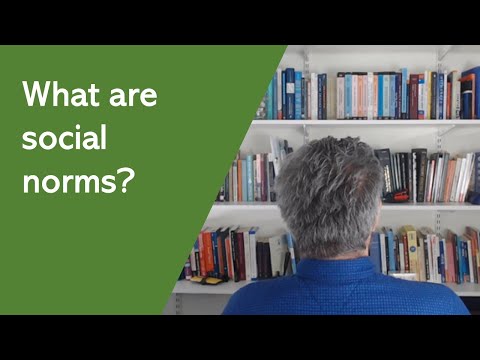
According to Professor G’s video “What Are Social Norms?”, social norms are the rules that people follow in their daily lives, even if they are not written down. These guidelines help individuals understand what is typical or acceptable in their community. Examples of social norms include waiting in line and saying “please” and “thank you.” As the video shows, people learn these behaviors from their family, friends, and culture. It also explains that when someone breaks a norm, others may judge or correct them. Overall, the video’s message is that while social norms help maintain order in society, they can also pressure individuals to fit in. This pressure becomes even more intense when you are new to a culture and constantly fearing that your lack of knowledge will expose you.
Social psychologists McDonald and Crandall, writing in the peer-reviewed journal Current Opinion in Behavioral Sciences (2015), explain that:
“Norms not only detail what is appropriate behavior, but these expectations in turn define what the group does, and who the group is. Identity is formed by group norms, and by conforming to them. Deviation from social norms leads first to communication designed to engender conformity, and if social expectations are not met and if the sexclusion.is important, deviation leads to loss of social status or exclusion.”
This shows that societal norms are not just ideas people follow but are also strongly enforced through social pressure. Straying from these behaviors results in social sanctions. Evolutionary behavioral researchers Schulz, Bahrami-Rad, Beauchamp, and Henrich (2015) argue that people tend to follow norms simply because others around them do, even when they don’t personally agree. This means that norms are reinforced not just by rules but by the fear of becoming the “black sheep.”
Humans are inherently social beings who depend on approval and a sense of belonging to guide their behavior, as psychologists Baumeister and Leary (1995) explain in their influential research on the need to belong. Because of this, many people go to great lengths to meet societal expectations, often out of fear of being left out, judged, or rejected. For individuals like me who are autistic or neurodivergent, feeling this social pressure can make it even harder to follow norms. Small behaviors, like interpreting social cues or socializing in public, are huge tasks I face daily and often make me feel isolated. This pressure is everywhere, from how we dress and speak to the careers we choose. Autism researchers Ropar Crompton, Flynn Evans-Williams and Fletcher-Watson (2020) found that while these shared expectations help maintain social order, they can also suppress individuality and make life difficult for people who naturally see or act differently This research explains why societal pressure can feel especially limiting for people whose ways of thinking differ from the majority.
Societal norms affect not just individuals but the way our whole society works, and that’s something we need to pay attention to. A lot of these rules and expectations tend to favor people who already fit into the dominant culture, while marginalized communities are often left dealing with exclusion or unfair disadvantages. When I say, “marginalized communities,” I’m talking about undocumented immigrants, neurodivergent individuals, refugees, and ethnic minorities. As someone who recently moved to the United States, I personally felt how challenging it is to adjust to a new culture and learn all its unwritten social rules. At first, I felt unwelcome and struggled to fit in, which left me feeling isolated and unsure of myself. Feeling left out makes it harder to even want to belong, because the constant sense of judgment can discourage you from trying to connect with people. And when you don’t know the norms and can’t easily make friends, integration becomes even harder. I want to strongly highlight how societal expectations can unintentionally push people aside simply because they don’t automatically fit in.
When society expects everyone to act the exact same way, it ends up shutting down creativity, diversity, and the kind of unique ideas that actually move the world forward. These pressures aren’t always obvious, but they slowly build up overtime and influence school, work, friendships, and even how we see ourselves. For people who move to a new culture, these norms can be especially confusing. Learning new social rules takes a lot of reflection and patience. Sure, it can make you feel stressed or self-conscious, but it also opens your eyes to something important. A lot of these rules are made up, and we don’t have to accept all of them without question.
To make norms less limiting, society needs to push for more critical thinking and empathy. People should get to decide which expectations actually make sense and which ones they don’t want to follow. We also need spaces where diversity is genuinely welcomed and different perspectives are respected and not just talked about. Doing this reduces social pressure while still keeping us connected. When belonging and individuality both matter, people can grow, succeed, and still stay true to who they are. Encouraging understanding and acceptance helps everyone, because it lets people express themselves freely while still being part of the community. My own journey shows how powerful it is when people have the room to learn, adapt, and be themselves without worrying about judgment.
At the end of the day, societal norms shape who we are and how we act, usually by pushing us toward conformity through social pressure. Understanding these norms and the expectations society puts on us plays a huge role in how we grow socially. Research shows that not following norms can hurt a person’s social status and lead to real consequences; for example, Cialdini and Trost (1998) explain that individuals who violate social norms are often judged more negatively and treated differently. And while these norms are supposed to help society function, they can also limit individuality. Thinking about all of this encourages us to question which rules actually help us and which ones we should let go of. My experiences as an autistic immigrant remind me that norms aren’t permanent, they can be reshaped to include rather than exclude. Change starts when we’re brave enough to question the rules we’ve been taught to accept.
References
Baumeister, R. F., & Leary, M. R. (1995). The need to belong: Desire for interpersonal attachments as a fundamental human motivation. Psychological Bulletin, 117(3), 497–529. https://doi.org/10.1037/0033-2909.117.3.497
Berry, J. W. (1997). Immigration, acculturation, and adaptation. Applied Psychology, 46(1), 5–34. https://doi.org/10.1111/j.1464-0597.1997.tb01087.x
Cialdini, R. B., & Trost, M. R. (1998). Social influence: Social norms, conformity, and compliance. In D. T. Gilbert, S. T. Fiske, & G. Lindzey (Eds.), The handbook of social psychology (4th ed., Vol. 2, pp. 151–192). McGraw-Hill.
Crompton, C., Ropar, D., Evans-Williams, C. V., Flynn, E., & Fletcher-Watson, S. (2020). Autistic adults’ experiences of social norms and everyday social interaction. Autism, 24(6), 1473–1486. https://doi.org/10.1177/1362361320908970
Mathers, J. (2025). invisible chains Archives – Jim Mathers. Jim Mathers. https://jimmathers.com/tag/invisible-chains/
McDonald, R. I., & Crandall, C. S. (2015). Social norms and social influence. Current Opinion in Behavioral Sciences, 3, 147–151. https://doi.org/10.1016/j.cobeha.2015.04.006
Professor G. (2020, June 2). What are social norms? [Video]. YouTube.
Szalavitz, M., & TIME.com. (2012, September 7). Why autistic kids make easy targets for school bullies. CNN. https://www.cnn.com/2012/09/07/health/autistic-kids-bullied-time
Schulz, J. F., Bahrami-Rad, D., Beauchamp, J. P., & Henrich, J. (2015). The origins of WEIRD psychology. Behavioral and Brain Sciences, 39, e1. https://doi.org/10.1017/S0140525X15000012

This entry is licensed under a Creative Commons Attribution-NonCommercial-ShareAlike 4.0 International license.

